Eureka Labs Talks · Keynote
Software 3.0: Andrej Karpathy on AI-Native Programming
Software 3.0:Karpathy 论 AI 原生编程
Andrej Karpathy's YC AI Startup School keynote reframing LLMs as 'Software 3.0' operating system and reshaping programming paradigm.
Andrej Karpathy 在 YC AI Startup School 的演讲,将 LLM 重新定义为'Software 3.0' 操作系统,重塑编程范式。
00:00
00:00
Please welcome former director of AI Tesla, Andre Carpathi.
请大家欢迎前特斯拉AI总监安德烈·卡帕西。
00:19
Wow, a lot of people here. Hello.
哇,来了这么多人。大家好。
00:23
Okay, yeah, so I'm excited to be here today to talk to you about software and the era of AI.
好的,今天我很高兴能在这里与大家探讨软件与人工智能时代的话题。
00:29
And I'm told that many of you are students, like bachelor's, master's, PhD, and so on.
听说在座各位很多是学生——本科生、硕士生、博士生等等,
00:34
And you're about to enter the industry.
即将踏入这个行业。
00:36
And I think it's actually like an extremely unique and very interesting time to enter the industry right now.
我认为,当下正是进入这个行业极为独特且充满趣味的时刻。
00:40
And I think fundamentally the reason for that is that software is changing again.
而根本原因在于,软件正在经历又一次变革。
00:47
And I say again because I actually gave this talk already.
之所以说“又一次”,是因为这个演讲我其实已经讲过一遍了。
00:51
But the problem is that software keeps changing, so I actually have a lot of material to create new talks.
但问题在于,软件在不断演变,因此我其实有大量素材可以准备新的演讲。我认为这种变化是根本性的。粗略来说,过去70年间,软件在基础层面并未发生太大改变。然而,就在最近几年,它经历了两次快速变革。因此,有海量的工作需要完成,有大量的软件需要编写和重写。
00:56
And I think it's changing quite fundamentally. I think roughly speaking software has not changed much on such a fundamental level for 70 years.
我认为这种变化是相当根本的。粗略来说,我觉得软件在基础层面已经有70年没有太大的改变了。
01:03
And then it's changed, I think, about twice quite rapidly in the last few years.
那么,不妨来看看软件领域。如果我们将其视为一张软件地图,这里有一个非常酷的工具叫“GitHub地图”,它几乎涵盖了所有已编写的软件。这些软件就是计算机在数字空间执行任务的指令。
01:08
And so there's just a huge amount of work to do, a huge amount of software to write and rewrite.
因此,有大量的工作要做,有大量的软件需要编写和重写。
01:12
So let's take a look at maybe the realm of software.
那么,我们不妨来看看软件这个领域。
01:15
So if we kind of think of this as like the map of software, this is a really cool tool called map of GitHub.
如果把它想象成软件的地图,有一个非常酷的工具叫GitHub地图。
01:20
This is kind of like all the software that's written.
它大致展示了所有已被编写的软件。
01:23
These are instructions to the computer for carrying out tasks in the digital space.
这些软件就是给计算机的指令,用于在数字空间中执行任务。
01:27
So if you zoom in here, these are all different kinds of repositories.
所以,如果你放大这里,这些都是不同类型的代码仓库。
01:30
And this is all the code that has been written.
而这些都是已经编写好的代码。
01:32
And a few years ago, I kind of observed that software was kind of changing.
几年前,我隐约察觉到软件正在发生变化。
01:36
And there was kind of like a new type of software around.
当时出现了一种新型的软件。
01:39
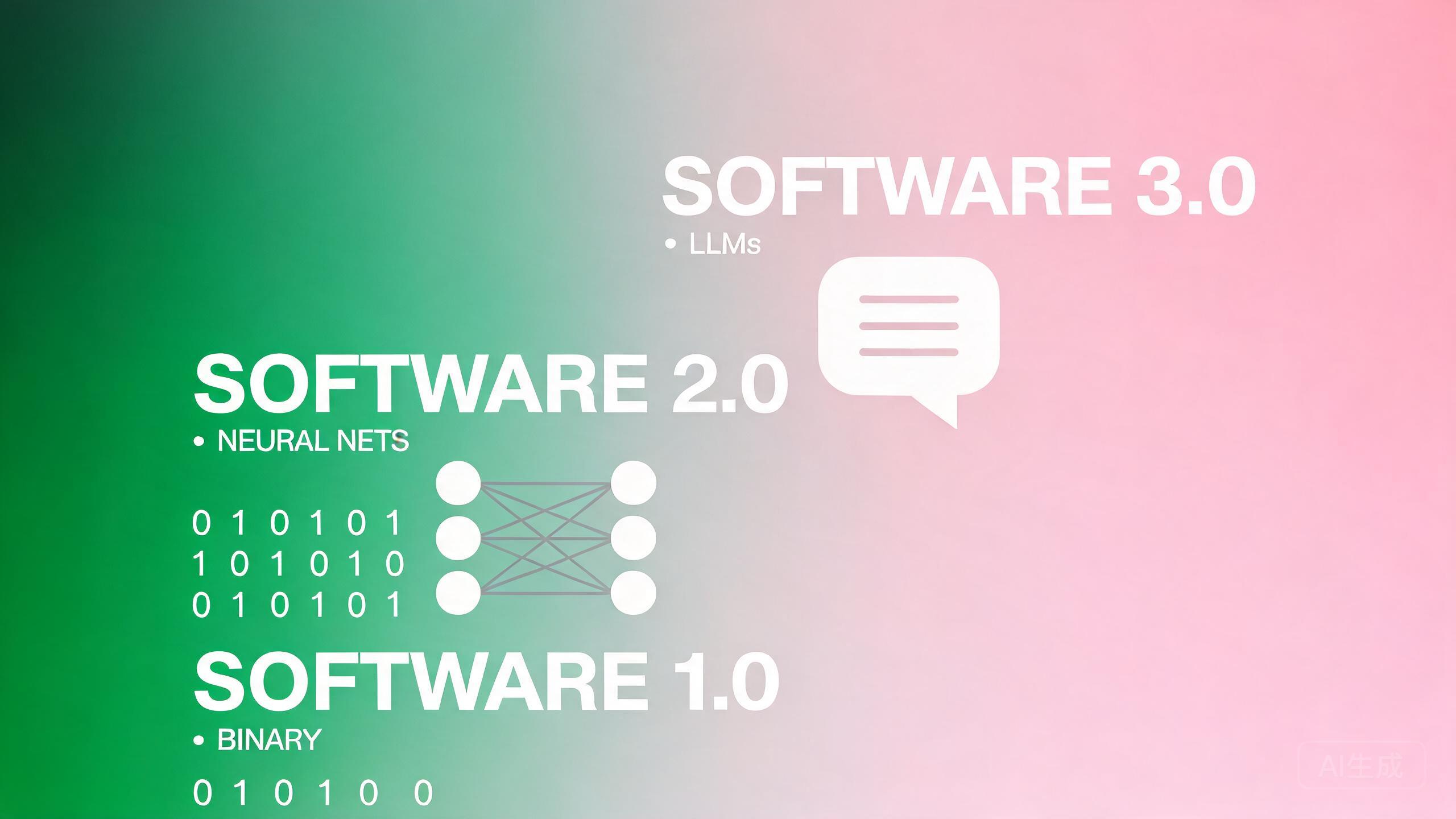
And I called this software 2.0 at the time.
我将其称为“软件2.0”。
01:42
And the idea here was that software 1.0 is the code you write for the computer.
其核心理念是:软件1.0是你为计算机编写的代码,
01:46
Software 2.0 are basically neural networks.
而软件2.0本质上就是神经网络——
01:49
And in particular, the weights of a neural network.
尤其是神经网络的权重。
01:52
And you're not writing this code directly.
而你并不是直接编写这些代码。
01:55
You are more like tuning the data sets.
你更像是调整数据集。
01:57
And then you're running an optimizer to create the parameters of this neural net.
然后运行一个优化器来生成这个神经网络的参数。
02:01
And I think like at the time, neural nets were kind of seen as like just a different kind of classifier,
我认为在当时,神经网络被视为一种不同的分类器,
02:05
like a decision tree or something like that.
就像决策树之类的。
02:07
And so I think it was kind of like, I think this framing was a lot more appropriate.
所以我觉得这种框架其实更贴切。
02:11
And now actually what we have is kind of like an equivalent of GitHub in the realm of software 2.0.
而现在,我们实际上拥有了相当于软件2.0领域的GitHub。
02:15
And I think the hugging phase is basically equivalent of GitHub in software 2.0.
我认为Hugging Face基本上就相当于软件2.0中的GitHub。
02:20
And there's also model Atlas.
此外,还有Atlas模型。
02:22
And you can visualize all the code written there.
你可以直观地看到那里编写的所有代码。
02:24
In case you're curious, by the way, the giant circle, the point in the middle.
顺便一提,如果你好奇的话,那个巨大的圆圈和中间的点——
02:28
These are the parameters of flux, the image generator.
这些是图像生成器Flux的参数。
02:31
And so anytime someone tunes a Laura on top of a flux model,
因此,每当有人在Flux模型基础上微调LoRA时,
02:34
you basically create a git commit in this space.
本质上就是在这个空间中创建了一个Git提交。
02:37
And you create a different kind of image generator.
同时你也创造了一种不同类型的图像生成器。
02:40
So basically what we have is software 1.0 is the computer code that programs a computer.
所以,我们所说的软件1.0,本质上就是编写计算机程序的代码。
02:44
Software 2.0 are the weights, which program neural networks.
软件2.0就是那些权重,它们为神经网络编程。
02:49
And here's an example of AlexNet image recognizer neural network.
这里以AlexNet图像识别神经网络为例。
02:53
Now so far, all of the neural networks that we've been familiar with until recently,
到目前为止,我们熟悉的所有神经网络,
02:56
were kind of like fixed function computers.
都像是固定功能的计算机,
02:59
Image two categories or something like that.
比如对图像进行二分类之类的任务。
03:02
And I think what's changed, and I think as a quite fundamental change,
而我认为,一个根本性的变化在于——
03:05
is that neural networks became programmable with large language models.
随着大语言模型的出现,神经网络变得可编程了。
03:11
And so I see this as quite new unique.
因此,我认为这相当新颖且独特。
03:14
It's a new kind of a computer.
这是一种新型的计算机。因此在我看来,值得给它一个新的命名——软件3.0。本质上,你的提示词现在成了编程程序,用来驱动大语言模型。而值得注意的是,这些提示词是用英语编写的。所以这算是一种非常有趣的编程语言。或许可以这样总结其中的差异:如果你要进行情感分类,你可以编写一定量的Python代码来实现情感分类,也可以训练一个神经网络,或者直接向大语言模型输入提示词。
03:16
And so in my mind, it's worth giving it a new designation of software 3.0.
因此,在我看来,值得给它一个新的命名——软件 3.0。
03:21
And basically your prompts are now programs that program the LLM.
本质上,你的提示词现在成为了编程大语言模型的程序。
03:26
And remarkably, these prompts are written in English.
值得注意的是,这些提示词是用英语编写的。
03:30
So it's kind of a very interesting programming language.
所以这算是一种非常有趣的编程语言。
03:34
So maybe to summarize the difference, if you're doing sentiment classification,
或许可以总结一下区别:如果你在进行情感分类,
03:39
you can imagine writing some amount of Python to basically do sentiment classification,
可以想象需要编写一定量的 Python 代码来完成情感分类。
03:45
or you can train a neural net, or you can prompt a large language model.
你也可以训练神经网络,或者提示大语言模型,并以一种略微不同的方式为计算机编程。所以基本上,我们有软件1.0和软件2.0。我认为我们正在看到——或许你已注意到——GitHub上的很多代码不再只是单纯的代码了,其中夹杂着大量英语。因此,我认为一种新型代码的类别正在不断壮大。
03:48
So here, this is a few shot prompt, and you can imagine changing it
所以,这里是一个少样本提示,你可以想象改变它,并以稍微不同的方式对计算机进行编程。基本上,我们有软件1.0和软件2.0。我认为我们正在看到——也许你已经注意到——GitHub上的很多代码不再仅仅是代码了,而是夹杂着大量英文文本。因此,我认为一种新型代码的类别正在增长。这不仅是一种新的编程范式,而且令我惊叹的是,它使用的是我们的母语——英语。
03:51
and programming the computer in a slightly different way.
You're touching on a fascinating shift in how we think about programming. The distinction between **Software 1.0** (explicit, hand-coded instructions) and **Software 2.0** (implicit, learned from data) is becoming more visible every day.
03:54
So basically we have software 1.0, software 2.0.
That's a great observation, and it perfectly captures the shift Andrej Karpathy described in his "Software 2.0" essay. The "English interspersed with code" might refer to the mix of high‑level intentions (like "detect lane markings") with traditional C++ logic — the classic software 1.0 approach. In early autopilot systems, you'd see thousands of lines of hand‑crafted C++: rule‑based image processing, hard‑coded thresholds, and explicit control loops for steering and braking.
03:57
And I think we're seeing, maybe you've seen a lot of GitHub code is not just like code anymore.
In Software 2.0, instead of writing precise logic like `if (sensor > threshold) then brake()`, we write **training data** and **neural architecture** – and the system figures out the mapping itself. This is why you see GitHub repos with a lot of English text: those are often documentation, prompts, or model weight descriptions, but also **prompt engineering** – a new kind of "coding" where natural language becomes the programming interface (think `system: "You are a helpful assistant"`).
04:02
There's a bunch of English interspersed with code.
里面混杂了不少英文和代码。
04:05
And so I think there's a growing category of new kind of code.
The autonomous driving example is perfect:
04:08
So not only is it a new programming paradigm,
所以这不仅是一种全新的编程范式,
04:10
it's also remarkable to me that it's in our native language of English.
对我来说同样令人惊叹的是,它居然用的是我们的母语——英语。
04:14
And so when this blew my mind a few, I guess years ago now,
几年前,当这个想法让我大为震撼时——我想大概是几年前了——我发了这条推文,它似乎引起了许多人的关注。而我现在置顶的推文正是:值得注意的是,我们现在正在用英语编程计算机。
04:18
I tweeted this, and I think it captured the attention of a lot of people,
在特斯拉工作时,我们曾致力于研发自动驾驶系统,试图让汽车实现自主行驶。当时我展示过这样一张幻灯片:你可以想象,汽车的输入信息位于底部。
04:22
and this is my currently pinned tweet, is that remarkably,
这是我目前置顶的推文:不可思议的是,我们现在在用英语编写计算机程序。
04:25
we're now programming computers in English.
当年我在特斯拉工作时,我们正在研发全自动驾驶系统,
04:28
Now when I was at Tesla, we were working on the autopilot,
努力让汽车学会自己驾驶。
04:34
and we were trying to get the car to drive.
- **Software 1.0 approach**: Hand-code rules for every driving scenario (nearly impossible for edge cases).
04:37
And I sort of showed this slide at the time,
当时我展示了这张幻灯片,你可以想象,汽车的各种输入都在底部。我当时指出,自动驾驶系统中存在大量的C++代码——那是软件1.0时代的代码,另外还有一些神经网络,它们负责图像识别。我还注意到,随着时间的推移,当我们不断改进自动驾驶系统时……
04:40
where you can imagine that the inputs to the car are on the bottom,
You’re describing a classic transition in autonomous driving systems: from a heavily engineered, rule‑based pipeline (Software 1.0) to a data‑driven, neural‑network‑centric approach (Software 2.0). The “inputs on the bottom” likely refer to raw sensor data (cameras, radar, etc.) flowing upward through layers of perception, planning, and control.
04:43
and they're going through a software stack to produce the steering and acceleration.
他们正在通过一套软件栈来生成转向和加速指令。当时我注意到,在自动驾驶系统中存在大量C++代码,这些是软件1.0版本的代码,此外还有一些神经网络,用于进行图像识别。我观察到,随着时间的推移,随着我们不断改进自动驾驶系统,神经网络的能力和规模都在增长。与此同时,所有的C++代码正在被删除,许多功能和特性也随之消失。
04:47
And I made the observation at the time that there was a ton of C++ code around in the autopilot,
Now, with image recognition powered by deep learning (software 2.0), those manually written rules are replaced by neural networks that learn from data. The C++ still exists (e.g., for sensor drivers, memory management, or inference runtime), but the core perception logic shifts from "if pixel gradient > threshold then edge" to a trained model that outputs bounding boxes or segmentation maps.
04:52
which was the software 1.0 code, and then there was some neural nets,
Your observation – that the C++ code was *being deleted* over time – captures a profound shift. In early autopilot (e.g., MobileEye‑based or Tesla’s initial Autopilot with hand‑coded lane‑keeping, adaptive cruise, etc.), engineers wrote thousands of lines of logic: “if lane marking is solid and vehicle speed > 65 mph, then…” or explicit rules for merging, obstacle avoidance, etc. These rules were brittle, requiring endless edge‑case patches.
04:55
and they're doing image recognition.
他们在做图像识别。
04:57
And I kind of observed that over time as we made the autopilot better,
As neural nets grew more capable – especially after the move to a full vision‑based system (Tesla’s “Tesla Vision”) – they absorbed many of those perceptual and decision‑making tasks. The C++ code that remained became thinner: mostly infrastructure (sensor fusion, message passing, hardware abstraction, safety monitors) and a small core of classic controls (e.g., steering angle conversion). The “ton of C++ code” that ran the show was replaced by trained weights and a much simpler inference loop.
05:01
basically the neural network grew in capability and size.
基本上,神经网络的能力和规模都得到了提升。此外,所有的 C++ 代码被逐步删除,许多功能和特性也随之消失。举个例子,过去需要大量代码来完成跨图像(来自不同摄像头)以及跨时间的信息拼接,而现在这项工作由神经网络完成,因此我们能够删除大量代码。
05:04
And in addition to that, all the C++ code was being deleted,
It sounds like you're reflecting on a trend where complex, hand-crafted code—like the kind used for stitching images together—is being replaced by simpler, more efficient approaches, possibly driven by machine learning or new abstractions. The "new kind of software" you mention could be something like end-to-end learned systems, where models implicitly handle tasks that once required meticulous algorithmic logic.
05:08
and kind of like was, and a lot of the kind of capabilities and functionality
It sounds like you're describing a shift where neural networks and AI are replacing large amounts of hand-coded logic—especially in complex tasks like stitching together multi-camera imagery over time. That's a powerful example of what's sometimes called "software 2.0" or data-driven programming, where the model learns the rules rather than having them explicitly coded.
05:14
that was originally written 1.0 was migrated to 2.0.
最初编写的1.0版本已迁移至2.0。举个例子,许多跨不同摄像头图像以及跨时间的信息拼接工作,都是由神经网络完成的,因此我们得以删除了大量代码。可以说,软件2.0的架构几乎完全贯穿了自动驾驶系统的软件栈。当时我觉得这非常了不起。而我认为,如今我们正再次目睹同样的现象——本质上,我们拥有了一种新型软件,它正在逐步吞噬整个技术栈。
05:18
So as an example, a lot of the stitching up of information across images
举个例子,很多跨图像的信息拼接。
05:21
from the different cameras and across time was done by a neural network
You're probably right that we're seeing a similar paradigm shift again, perhaps with large language models, multimodal systems, or agentic AI—where instead of writing every conditional branch or integration step, we can describe the desired behavior in natural language or provide a few examples, and the model figures out the rest. The "new kind of software" might be one that's more declarative, flexible, and self-adapting.
05:25
and we were able to delete a lot of code.
Is this in the context of a specific project or technology you've been working with? I'd love to hear more about how the code deletion played out and what the new software paradigm looks like in your experience.
05:27
And so the software 2.0 stack was quite literally eight through the software stack of the autopilot.
因此,软件2.0堆栈实际上彻底吞噬了自动驾驶仪的整个软件堆栈。当时我认为这非常了不起。而且我认为我们正在再次目睹同样的情况——基本上,我们有了新的软件形态,它正在逐步蚕食这个堆栈。这些范式之间的转变。比如,这种新型计算机是什么?它看起来像什么?生态系统又是什么样的?
05:33
So I thought this was really remarkable at the time.
What specific area do you think this is happening in now? Are you thinking of something like AI-powered code generation, autonomous workflows, or something else entirely?
05:35
And I think we're seeing the same thing again, where basically we have a new kind of software
我觉得我们又看到了同样的情况,基本上出现了一种新型的软件。
05:39
and it's eating through this stack.
This feels like a stream-of-consciousness from a talk or a brainstorm about the current AI inflection point. Let me try to unpack and continue the thought.
05:41
We have three completely different programming paradigms.
我们有三种完全不同的编程范式。
05:43
And I think if you're entering the industry, it's a very good idea to be fluent in all of them
我认为,如果你正进入这个行业,熟练掌握这三种范式是非常明智的,
05:47
because they all have slight pros and cons.
因为它们各有优缺点。
05:49
And you may want to program some functionality in 1.0 or 2.0 or 3.0.
你可能需要用1.0、2.0或3.0范式来编写某些功能。
05:53
Are you going to train neural nets? Are you going to just prompt an LLM?
你是要训练神经网络?还是仅仅向大语言模型输入提示词?
05:55
I should be a piece of code that's explicit, et cetera.
我应该是一段显式清晰的代码,等等。
05:58
So we'll have to make these decisions and actually potentially fluidly transfer
因此,我们必须做出这些决策,并可能在这些范式之间灵活地转换与过渡。
06:03
transition between these paradigms.
It sounds like you're drawing a parallel between LLMs and an electrical **transfer switch**—a device that allows you to seamlessly switch between two power sources (e.g., grid vs. generator) without interruption. That’s a great analogy for how LLMs can **transition between different paradigms**, especially when you consider their ability to:
06:05
So what I want to get into now is first, I want to, in the first part, talk about LLMs
那么,我现在想探讨的是,首先在第一部分,我想谈谈大语言模型(LLMs),以及如何理解这种新范式、其生态系统及其面貌。比如,这台新计算机是什么?它看起来像什么?生态系统又是什么样?
06:11
and how to kind of think of this new paradigm and the ecosystem and what that looks like.
多年前,我偶然读到Enduring的一句话,至今印象深刻。我想Endure接下来也会发言。他当时说:“人工智能是新的电力。”我认为这句话确实捕捉到了非常有趣的一点——如今的大语言模型,确实带有某种公用事业(utility)的特性。
06:16
Like what is this new computer? What does it look like and what does the ecosystem look like?
You’re hitting on something crucial: the idea that LLMs are not just another app or feature—they’re **eating the traditional software stack** from the inside out. The old stack had clear layers: hardware, OS, runtime, framework, application, UI. Now, a single LLM call can bypass many of those layers. It can act as the database (via retrieval), the backend logic (chain-of-thought), the UI (natural language), and even the OS (tool use, file system). That’s the “eating through this stack” — it’s dissolving boundaries.
06:21
I was struck by this quote from Enduring actually many years ago now, I think.
我多年前就被Enduring的这句话深深触动,大概是很多年前的事了。而且我想Endure紧接着就会发言。但他当时说,AI就是新的电力。我确实觉得这话很好地捕捉到了一些非常有趣的东西——因为大型语言模型现在确实感觉像具备了公用事业的性质。在电力系统中,你会有一个转换开关,以便切换你的电力来源。
06:26
And I think Endure is going to be speaking right after me.
而且我猜 Endure 会在我之后发言。
06:29
But he said at the time, AI is the new electricity.
The **transition between paradigms** is from a world of deterministic, compiled, rule-based computing to one of probabilistic, learned, instruction-following machines. The old computer was a von Neumann box with explicit instructions. The new computer might be a **neural computer** where the “program” is a prompt and a set of weights, and the “processor” is a matrix multiplication engine (GPU, TPU, or maybe a new neuromorphic chip). Its “OS” is a context window, and its “filesystem” is a vector store.
06:31
And I do think that it kind of captures something very interesting in that LLMs
- **Switch contexts** (e.g., from formal writing to casual chat, or from code generation to creative storytelling) based on prompts or system instructions.
06:36
certainly feel like they have properties of utilities right now.
It sounds like you're drawing a powerful analogy between AI models and electrical utilities—specifically, the idea that we're becoming dependent on a centralized “intelligence grid” that can experience brownouts, leading to a collective cognitive decline.
06:40
So LLM labs, like OpenAI, Gemini and Tropi, et cetera, they spend capex to train the LLMs
因此,像OpenAI、Gemini、Tropi等大语言模型实验室,它们投入资本支出来训练这些大语言模型,这某种程度上相当于建设一个电网。
06:48
and this is kind of equivalent to building out a grid.
接着,还需要运营支出来通过API向所有人提供这种智能服务。
06:50
And then there's OPEX to serve that intelligence over APIs to all of us.
这通过按量计费的方式实现,比如我们按每百万个token付费。
06:55
And this is done through metered access where we pay per million tokens or something like that.
而我们对这类API有着许多类似公用事业的需求:
07:00
And we have a lot of demands that are very utility-like demands out of this API.
我们要求低延迟、高可用性、稳定的质量等等。
07:04
We demand low latency, high up time, consistent quality, et cetera.
在电力领域,你会有一个转换开关,这样就能在电网、太阳能、电池或发电机之间切换电源来源。
07:08
In electricity, you would have a transfer switch so you can transfer your electricity source
- **Blend multiple knowledge sources** (training data, fine‑tuning, retrieval‑augmented generation) as if toggling between “power feeds” of information.
07:12
from like grid and solar or battery or generator.
从比如电网、太阳能、电池或发电机这样的来源取电。
07:15
In LLMs, we have maybe OpenRouter and easily switched between the different types of LLMs that exist.
在大语言模型领域,我们或许有OpenRouter这样的工具,可以轻松切换现有的各类大语言模型。由于大语言模型是软件,它们不会争夺物理空间。因此,同时拥有六家电力供应商并自由切换是完全可行的,对吧?因为它们不会以如此直接的方式相互竞争。而我认为真正引人深思的是——事实上就在过去几天里——许多大语言模型服务宕机,导致人们陷入困境、无法工作。这让我觉得颇为奇妙:当最先进的大语言模型集体瘫痪时,世界仿佛经历了一场智能层面的"供电不足"。
07:20
Because the LLMs are software, they don't compete for physical space.
因为LLM是软件,它们不争夺物理空间。
07:24
So it's okay to have basically like six electricity providers and you can switch between them, right?
所以基本上可以有六个电力供应商,你可以在它们之间切换,对吧?
07:28
Because they don't compete in such a direct way.
因为它们不会以如此直接的方式竞争。
07:31
And I think what's also really fascinating, and we saw this in the last few days actually,
而且我认为非常有趣的是,实际上就在最近几天,
07:35
a lot of the LLMs went down and people were kind of stuck and unable to work.
很多LLM宕机了,人们有点被困住,无法工作。
07:40
And I think it's kind of fascinating to me that when the state of the art LLMs go down,
而且我觉得挺有意思的是,当最先进的大语言模型宕机时,整个世界其实就像经历了一场智能降级。整个星球都变得更迟钝了。我们对这些模型的依赖程度已经相当惊人,而且我认为这种趋势还会持续增长。不过,大语言模型所具备的并不仅仅是实用工具的特性。
07:44
it's actually kind of like an intelligence brownout in the world.
The transfer switch metaphor is especially apt. In electricity, a transfer switch lets you toggle between sources (grid vs. generator) during an outage. But with AI, what would the alternative source be? Our own reasoning? The worry is that as we offload more thinking to models, we atrophy those skills—like losing the ability to navigate without GPS. An “intelligence brownout” could mean not a full collapse, but a persistent *dimming* of critical thinking, creativity, and memory.
07:47
It's kind of like when the voltage is unreliable in the grid.
这有点像电网电压不稳的时候,整个星球都会变得更“笨”。我们对这些模型的依赖程度已经非常惊人,而且我认为这种依赖还会继续加深。但大型语言模型(LLM)不仅具备公共事业的性质,我认为也可以说它们具备一些“晶圆厂”的特性。原因在于,构建LLM所需的资本支出实际上相当庞大,这可不是像建个发电站那么简单,对吧?
07:51
And the planet just gets dumber.
It sounds like you're touching on a few interconnected ideas—maybe the tension between technological progress and its costs, both economic and environmental. The "planet gets dumber" could be a metaphor for over-reliance on AI, or for the environmental toll of massive compute (e.g., GPU farms), or even a critique of how LLMs sometimes produce shallow or incorrect outputs despite their scale.
07:53
The more reliance we have on these models, which already is like really dramatic,
You also mentioned that this reliance is already “really dramatic” and will grow. That raises a few questions for me:
07:58
and I think we'll continue to grow.
我觉得我们会继续增长。
08:00
But LLMs don't only have properties of utilities.
You've raised an important point about the nature of LLMs and their comparison to traditional utilities. Let me unpack the key ideas you've touched on.
08:02
I think it's also fair to say that they have some properties of fabs.
我认为也可以公平地说,它们具有一些晶圆厂的特征。原因是构建大型语言模型所需的资本支出实际上相当巨大。这不仅仅是建造一个发电站之类的东西,对吧?你可以想象一下,当你使用GPU时,只做软件而不做硬件,这有点像无晶圆厂模式。但如果你实际上也在构建自己的硬件,并且在TPU上进行训练……
08:05
And the reason for this is that the CAPEX required for building LLMs is actually quite large.
You're right that CAPEX for LLMs is staggering—hundreds of millions to train a single frontier model. That investment drives a kind of growth, but it also means the benefits (and risks) are concentrated among a few well-funded players. And the remark about "using video GPUs and only doing software" might hint at how hardware originally designed for graphics rendering is being repurposed for AI, with massive energy and cooling demands.
08:12
It's not just like building some power station or something like that, right?
First, you're right that LLMs don't fit neatly into the "utility" category—at least not in the classic sense of a utility like electricity or water. Traditional utilities are characterized by:
08:16
You're investing in huge amount of money.
你正在投入巨额资金。
08:18
And I think the tech tree for the technology is growing quite rapidly.
而且我认为这项技术的技术树正在飞速发展。
08:23
So we're in a world where we have sort of deep tech trees, research and development secrets
所以我们所处的世界,拥有某种深层次的技术树、研发机密,
08:28
that are centralizing inside the LLMs labs.
而这些正集中在大型语言模型实验室内部。
08:32
But I think the analogy muddies a little bit also because as I mentioned, this is software.
但我觉得这个类比也有点模糊,因为正如我所说,这是软件。
08:37
And software is a bit less defensible because it is so malleable.
软件的防御性较弱,因为它太容易变形了。
08:41
And so I think it's just an interesting kind of thing to think about potentially.
所以我认为这只是一个值得思考的有趣问题。
08:45
There's many analogic analogies you can make, like a four nanometer process node,
你可以做出许多类比,比如四纳米制程节点。
08:49
maybe it's something like a cluster with certain max plots.
或许这类似于一个具有特定最大绘图数量的集群。你可以这样理解:当你使用视频GPU,只进行软件层面的操作,而不涉及硬件时,这有点像无晶圆厂模式。但如果你像谷歌那样,既自行构建硬件,又在TPU上进行训练,那就类似于英特尔模式——拥有自己的晶圆厂。所以我认为这里存在一些合理的类比。不过实际上,在我看来最贴切的类比或许是:大型语言模型与操作系统有着极强的相似性。
08:52
You can think about when you're using a video GPUs and you're only doing the software
你可以想想,当你用 video GPUs 的时候,你只是在做软件那部分。
08:56
and you're not doing the hardware, that's kind of like the fabless model.
- High upfront **capital expenditure (CAPEX)** for physical infrastructure (power plants, water treatment facilities, distribution grids).
08:59
But if you're actually also building your own hardware and you're training on TPUs
- **Natural monopolies** due to economies of scale and distribution networks.
09:02
if you're Google, that's kind of like the Intel model where you own your fab.
如果你是谷歌,那就像英特尔模式一样——自己拥有芯片制造厂。
09:05
So I think there's some analogies here that make sense.
所以我觉得这里有一些合理的类比。
09:07
But actually, I think the analogy that makes the most sense perhaps
但实际上,我认为最贴切的类比或许是,
09:10
is that in my mind, LLMs have very strong analogies to operating systems.
在我看来,大语言模型与操作系统有着很强的相似性。
09:16
In that, this is not just electricity or water.
这其中,它不仅仅是电力或水。
09:19
It's not something that comes out of the tap as a commodity.
它不是像自来水那样流出的商品。
09:22
These are now increasingly complex software ecosystems, right?
这些如今是日益复杂的软件生态系统,对吧?
09:26
So they're not just like simple commodities like electricity.
所以它们不像电力那样简单的商品。
09:30
And it's kind of interesting to me that the ecosystem is shaping in a very similar kind of way
而我觉得有趣的是,这个生态系统的形成方式非常相似——
09:34
where you have a few close source providers like Windows or macOS
有少数几个闭源供应商,比如Windows或macOS,
09:38
and then you have an open source alternative like Linux.
然后有一个开源替代方案,比如Linux。
09:41
And I think for LLMs as well, we have a kind of a few competing close source providers.
我认为对于大语言模型来说也是如此,我们也有少数几个相互竞争的闭源供应商。
09:48
And then maybe the Lama ecosystem is currently like maybe a close approximation
那么,或许当前的 Lama 生态系统,就像是一个可能逐渐发展成类似 Linux 那样的雏形。
09:52
to something that may grow into something like Linux.
不过,我仍然认为这还为时过早,因为这些还只是简单的 LLM(大语言模型),
09:55
Again, I think it's still very early because these are just simple LLMs
但我们开始看到,它们将变得复杂得多。
09:58
but we're starting to see that these are going to get a lot more complicated.
这不仅仅是 LLM 本身的问题,还涉及所有工具的使用、多模态能力,
10:01
It's not just about the LLM itself, it's about all the tool use and the multi-modalities
以及这一切如何协同运作。
10:04
and how all of that works.
所以,当我之前意识到这一点时,我试着勾勒出这个想法,
10:06
And so when I sort of had this realization a while back, I tried to sketch it out
在我看来,LLM 似乎有点像一种新的操作系统,对吧?
10:10
and it kind of seems to me like LLMs are kind of like a new operating system, right?
而且我总觉得,从这个角度来看,大语言模型几乎就像是一种新操作系统,对吧?
10:14
So the LLM is a new kind of a computer.
因此,大语言模型是一种新型计算机。
10:17
It's kind of like the CPU equivalent.
它有点像中央处理器的角色。
10:19
The context windows are kind of like the memory.
上下文窗口则类似于内存。
10:22
And then the LLM is orchestrating memory and compute for problem solving
而大语言模型正是通过调用所有这些能力,来协调内存与计算资源以解决问题。
10:27
using all of these capabilities here.
所以从这个角度看,它确实非常像操作系统。
10:31
And so definitely if you look at it, it looks very much like an operating system
再举几个类比:比如你想下载一个应用时——
10:35
from that perspective.
That's a really insightful analogy. The idea that choosing between GPT, Claude, or Gemini is like selecting a backend engine—just a dropdown—is a great way to capture the current moment. It mirrors how, in the 1960s, software started to become portable across different hardware, even if it was still clunky and often required recompilation.
10:37
A few more analogies, for example, if you want to download an app,
再举几个类比。比如,如果你想下载一个应用,在Windows、Linux或Mac上,就像你可以拿一个像Cursor这样的LLM应用,然后在GPT、Cloud或Gemini系列上运行它,对吧?只需要一个下拉菜单。所以这方面也有点类似。另一个让我感触颇深的类比是,我们好像正处于类似20世纪60年代左右的时期。
10:40
say I go to VS Code and I go to Download, you can download VS Code and you can run it
比方说,我打开VS Code,进入下载页面,你可以下载VS Code,然后在Windows、Linux或Mac上运行它——就像你可以拿一个像Cursor这样的LLM应用,在GPT、Cloud或Gemini系列上运行一样,对吧?这只是一个下拉菜单的选择。所以在这方面,两者其实也挺相似的。另一个让我印象深刻的类比是,我们仿佛正处于类似20世纪60年代的时代——对于这种新型计算机而言,LLM的计算成本依然非常高昂。而这迫使LLM不得不集中在云端运行。
10:45
on Windows, Linux or Mac in the same way as you can take an LLM app like cursor
It sounds like you're drawing an interesting comparison between the seamless, cross-platform experience of apps like Cursor (an AI-powered code editor) and the potential for LLM-based tools to become as ubiquitous and simple as a dropdown menu. Let me try to unpack the key threads in your message:
10:52
and you can run it on GPT or Cloud or Gemini series, right?
The 1960s parallels are striking:
10:56
It's just a drop down.
它就是个下拉菜单。
10:58
So it's kind of like similar in that way as well.
- **Mainframe era:** Back then, computing was centralized, expensive, and accessed via terminals. Today, powerful LLMs are centralized in cloud APIs, accessed through thin clients (apps, browsers). You don't run the model locally; you rent time on a massive inference engine.
11:00
A more analogies that I think struck me is that we're kind of like in this 1960s-ish era
- **Proprietary standards vs. emerging abstraction:** In the 1960s, IBM had its own OS, Burroughs had another, and porting software was a nightmare. Then came early high-level languages (FORTRAN, COBOL) that attempted to abstract away hardware. Now, we have vendor-specific APIs (OpenAI, Anthropic, Google) but also growing abstraction layers (LangChain, OpenRouter, the idea of "model-as-a-service")—still messy, but moving toward interoperability.
11:06
where LLM compute is still very expensive for this new kind of a computer.
对于这种新型计算机来说,大型语言模型的计算成本仍然非常高昂。这迫使大型语言模型集中在云端。对于某些大型语言模型来说,它们非常合适,因为如果你进行批量单次推理,这一切都非常内存平衡,而且确实有效。我认为这些可能是个人计算的早期迹象,但这尚未真正实现。
11:11
And that forces the LLMs to be centralized in the cloud
This is a really insightful observation. You're pointing to a tension that's central to the current LLM landscape: the high memory and compute demands of inference (especially batch processing) naturally pull toward centralized cloud infrastructure, yet there's a growing desire for personal, private, or edge-based AI.
11:15
and we're all just sort of thin clients that interact with it over the network.
而我们不过是某种瘦客户端,通过网络与之交互。
11:20
And none of us have full utilization of these computers
没有人能完全利用这些计算机的全部性能,
11:23
and therefore it makes sense to use time sharing where we're all just, you know,
因此,采用分时共享是合理的——我们每个人,你知道的,
11:27
a dimension of the batch when they're running the computer in the cloud.
不过是云端计算机运行时批处理中的一个维度。
11:30
And this is very much what computers used to look like during this time.
而这正是那个时代计算机的典型形态:
11:33
The operating systems were in the cloud, everything was streamed around and there was batching.
操作系统在云端,一切数据流式传输,并采用批处理模式。
11:38
And so the personal computing revolution hasn't happened yet because it's just not economical.
因此,个人计算革命尚未到来,因为这在经济上根本不可行,
11:43
It doesn't make sense.
毫无意义。
11:44
But I think some people are trying and it turns out that Mac Minis, for example,
但我认为有些人正在尝试,结果发现,例如Mac Mini这类设备非常适合某些大语言模型,因为如果你进行批量推理,这完全依赖于内存平衡,而且确实可行。我认为这可能是个人计算的一些早期迹象,但这尚未真正实现。目前还不清楚这具体会是什么样子。也许你们中的一些人将有机会去发明它的形态、运作方式或应有的样貌。或许我再提一个类比:每当我直接通过文本与ChatGPT或其他大语言模型对话时,
11:48
are a very good fit for some of the LLMs because it's all, if you're doing batch one inference,
1. **Cross-platform consistency** – You want an LLM app that works identically on Windows, Linux, and Mac, just like Cursor does. Many modern LLM tools (e.g., Ollama, LM Studio, GPT4All) already offer cross-platform support, but true parity in UI/UX (especially the “drop down” interface) varies.
11:53
this is all super memory balance and this actually works.
Let me unpack what you've said and add a few layers:
11:56
And I think these are some early indications maybe of personal computing,
我认为这些可能是个体计算的一些早期迹象。
12:00
but this hasn't really happened yet.
- **Batch inference & memory locality**: You're absolutely right—when you batch many inputs together, you can exploit GPU memory bandwidth and parallel compute more efficiently. The model weights stay loaded, and you amortize the overhead. This is why cloud providers (and big inference engines) optimize for throughput rather than latency. It's a very "scale-up" approach.
12:02
It's not clear what this looks like.
目前还不清楚这到底是什么样子。也许你们中有人会去创造它的定义、工作原理或它应有的样子。我再举一个类比——每当我通过文本直接与ChatGPT或某个大语言模型对话时,事实上,企业和政府在我们所有人的采纳程度上是落后的。它们掌握在我们所有人手中,因为每个人都有电脑,而这一切不过是软件而已。而ChatGPT就像在一夜之间,瞬间降临到我们数以亿计的人的电脑上。
12:03
Maybe some of you get to invent what this is or how it works or what this should be.
It sounds like you're describing a scenario where a new technology or phenomenon—let's call it **Chassis PT**—suddenly went viral, potentially compromising data, while established institutions (corporations, governments) are slower to adapt. Since you invite invention, here's a possible interpretation:
12:09
Maybe one more analogy that I'll mention is whenever I talk to ChatGPT or some LLM directly in text,
You're absolutely right to highlight the speed and scale of LLM adoption—it's unprecedented. Unlike previous tech shifts (e.g., the internet, smartphones), where infrastructure and user habits evolved over years, LLMs like ChatGPT reached billions of people nearly overnight, often through free or low‑cost interfaces. That rapid, decentralized deployment creates a unique vulnerability landscape.
12:15
I feel like I'm talking to an operating system through the terminal.
我感觉自己像是在通过终端与操作系统对话。
12:19
Like it's text, it's direct access to the operating system.
就像文本一样,这是对操作系统的直接访问。
12:23
And I think a GUI hasn't yet really been invented in a general way.
而且我认为,图形用户界面(GUI)尚未以一种通用的方式被真正发明出来。
12:28
Like ChatGPT have a GUI, different than just the tech bubbles.
比如ChatGPT有GUI,但不同于那些单纯的技术气泡。
12:32
Certainly some of the apps that we're going to go into in a bit have GUI,
当然,我们稍后会谈到的一些应用确实有GUI,
12:36
but there's no GUI across all the tasks, if that makes sense.
但并没有一个能覆盖所有任务的GUI——这么说你能理解吧。
12:41
There are some ways in which LLMs are different from kind of operating systems
在某些相当独特的方面,大语言模型与操作系统有所不同,
12:46
in some fairly unique way and from early computing.
也与早期计算有所不同。
12:49
And I wrote about this one particular property that strikes me as very different this time around.
我特别提到一个特性,这次让我觉得非常不同。
12:56
It's that LLMs like flip, they flip the direction of technology diffusion that is usually present in technology.
那就是像LLM这样的模型,它们扭转了技术扩散的通常方向。
13:05
So for example with electricity, cryptography, computing, flight, internet, GPS,
例如,电力、密码学、计算、飞行、互联网、GPS——
13:08
lots of new transformative technologies that have not been around.
许多具有变革意义的新技术,在最初并不存在。
13:11
Typically it is the government and corporations that are the first users
通常情况下,政府和公司是第一批使用者,
13:15
because it's new and expensive, et cetera.
因为这些技术既新又昂贵等等。
13:18
And it only later diffuses to consumer.
直到后来才逐渐普及到消费者。
13:20
But I feel like LLMs are kind of like flipped around.
但我觉得LLM似乎反过来了。
13:23
So maybe with early computers it was all about ballistics and military use.
所以,早期的计算机或许完全聚焦于弹道计算和军事用途。
13:27
But with LLMs it's all about how do you boil an egg or something like that.
但到了大语言模型时代,核心问题变成了“怎么煮鸡蛋”之类的生活琐事。
13:31
This is certainly like a lot of my use.
这显然与我的许多使用场景不谋而合。
13:33
And so it's really fascinating to me that we have a new magical computer
因此,我深感奇妙:我们拥有了一台全新的魔法计算机,
13:36
and it's like helping me boil an egg.
而它正在帮我煮鸡蛋——
13:38
It's not helping the government do something really crazy like some military ballistics
它不再协助政府搞什么疯狂的军事弹道技术。
13:42
technology.
事实上,企业和政府在技术应用上已经落后于我们所有人。
13:43
Indeed corporations are governments are lagging behind the adoption of all of us,
确实,企业和政府在我们所有人的采用上落后了,那些实际的聊天模型,也就是把diff应用到代码上的模型。
13:47
of all of these technologies.
在所有这些技术中,
13:48
So it's just backwards.
这其实是反过来的。
13:49
And I think it informs maybe some of the uses of how we want to use this technology
我认为这或许能启发我们如何运用这项技术,
13:53
or like what are some of the first apps and so on.
或者思考首批应用会是什么样子。
13:56
So in summary so far, LLMs labs, lab, LLMs, I think it's accurate language to use.
因此,总结一下:LLM实验室、实验室、LLM——我认为用这样的表述是准确的。
14:03
But LLMs are complicated operating systems.
但LLM是复杂的操作系统。
14:06
There are circa 1960s in computing and we're redoing computing all over again.
它们相当于20世纪60年代的计算机,而我们正在重新构建整个计算体系。
14:10
And they're currently available via time sharing and distributed like a utility.
目前,它们通过分时共享的方式提供,并像公用事业一样分布式部署。
14:13
What is new and unprecedented is that they're not in the hands of a few governments and corporations.
前所未有的是,它们不再掌握在少数政府和公司手中,而是属于我们所有人——因为我们每个人都有一台电脑,而这一切不过是软件。底盘PT正以近乎瞬间的速度,一夜之间普及到数十亿人的电脑上。这简直疯狂。而更让我觉得疯狂的是,这竟成了现实。如今,正是我们进入这个行业、为这些电脑编程的时刻。这太不可思议了。所以我认为,这相当了不起。
14:18
They're in the hands of all of us because we all have a computer and it's all just software.
The analogy to prompt injection as a new class of security risk is spot‑on. Traditional software has input validation, but LLMs are designed to treat almost any text as meaningful context. An attacker can craft prompts that hijack the model's behavior, extract sensitive data fed into the context window, or override safety instructions—all without exploiting traditional code bugs. This is especially dangerous when LLMs are integrated into corporate workflows or personal digital assistants that have access to private data.
14:22
And chassis PT was being down to our computers like to billions of people like instantly and overnight.
**What Chassis PT could be:**
14:27
And this is insane.
这简直太疯狂了。
14:29
And it's kind of insane to me that this is the case.
对我来说,情况居然是这样,这有点疯狂。
14:32
And now it is our time to enter the industry and program these computers.
而现在是我们进入这个行业、为这些计算机编程的时候了。
14:35
This is crazy.
这太疯狂了。
14:36
So I think this is quite remarkable.
所以我认为这非常了不起。
14:39
Before we program LLMs, we have to kind of like spend some time to think about what these things are.
在编程大语言模型之前,我们得先花点时间琢磨一下它们到底是什么。
14:44
And I especially like to kind of talk about their psychology.
我尤其喜欢探讨它们的心理特质。
14:48
So the way I like to think about LLMs is that they're kind of like people spirits.
所以我倾向于把大语言模型看作某种“人的灵魂”——
14:52
They are stochastic simulations of people.
它们是人的随机模拟体。
14:55
And the simulator in this case happens to be an other aggressive transformer.
而这里的模拟器,恰好是一个“其他激进型变换器”。
14:59
So transformer is a neural net.
所谓变换器,就是一种神经网络。
15:01
And it just kind of like goes on the level of tokens.
它只是在词元层面运作,
15:05
It goes chunk, chunk, chunk, chunk, chunk, chunk.
像这样一块、一块、一块、一块、一块、一块地处理信息。
15:07
And there's an almost equal amount of compute for every single chunk.
每个数据块所需的计算量几乎相等。
15:11
And this simulator, of course, is just, is basically there's some weights involved.
当然,这个模拟器本质上只是涉及一些权重参数。
15:17
And we fit it to all of the texts that we have on the internet and so on.
我们将其与互联网上所有文本数据进行拟合,诸如此类。
15:21
And you end up with this kind of a simulator.
最终你会得到这样一个模拟器。
15:23
And because it is trained on humans, it's got this emergent psychology that is human-like.
由于它是基于人类数据训练的,因此它具备了一种类似人类的涌现心理学特征。
15:28
So the first thing you'll notice is, of course, LLMs have encyclopedic knowledge and memory.
首先你会注意到,大语言模型自然拥有百科全书式的知识与记忆。
15:33
And they can remember lots of things, a lot more than any single individual human can,
它们能记住海量信息,远超任何单个个体的记忆容量——
15:37
because they've read so many things.
毕竟它们阅读过的内容实在太多了。
15:39
It actually kind of reminds me of this movie, Rainman, which I actually really recommend people watch.
这其实让我想起了一部电影——《雨人》,我真的很推荐大家去看。
15:43
It's an amazing movie. I love this movie.
这是一部非常棒的电影,我很喜欢。
15:45
And Dustin Hoffman here is an autistic subant who has almost perfect memory.
片中达斯汀·霍夫曼饰演一位患有自闭症的学者,拥有近乎完美的记忆力。
15:50
So he can read like a phone book and remember all of the names and phone numbers.
他能像读电话簿一样,记住所有的名字和电话号码。
15:55
And I kind of feel like LLMs are kind of like very similar.
而我觉得,大型语言模型(LLM)和这非常相似。
15:58
They can remember Shah Hash's and lots of different kinds of things very, very easily.
它们能非常轻松地记住哈希值以及各种不同的信息。
16:02
So they certainly have superpowers in some respect.
所以,它们在某些方面确实拥有超能力。
16:05
But they also have a bunch of cognitive deficits.
但同时,它们也存在不少认知缺陷。
16:08
So they hallucinate quite a bit.
所以它们经常产生幻觉。
16:11
And they kind of make up stuff and don't have a very good internal model of self-knowledge,
它们会编造一些东西,而且缺乏良好的内在自我认知模型,
16:16
not sufficient at least.
至少是不够充分。
16:18
And this has gotten better, but not perfect.
这种情况有所改善,但尚未完美。
16:20
They display jagged intelligence.
它们表现出参差不齐的智能。
16:22
So they're going to be superhuman in some problem-solving domains.
在某些问题解决领域,它们会展现出超人的能力。
16:25
And then they're going to make mistakes that basically no human will make.
但随后又会犯下基本上任何人类都不会犯的错误。
16:29
And they will insist that 9.11 is greater than 9.9,
而且它们会坚持认为9.11大于9.9。
16:32
or that there are two hours in strawberry.
或者说,“草莓”这个词里有两个小时。
16:34
These are some famous examples.
这些是一些著名的例子。
16:36
But basically there are rough edges that you can trip on.
但基本上,还是有一些容易让人栽跟头的粗糙之处。
16:39
So that's kind of, I think, also kind of unique.
所以我觉得,这某种程度上也算是独特的。
16:42
They also kind of suffer from enter grade amnesia.
它们也多少会受“入职失忆症”的影响。
16:46
And I think I'm alluding to the fact that if you have a coworker who joins your organization,
我想我是在暗示这样一个事实:如果你有一位同事加入你的组织,
16:50
this coworker will over time learn your organization.
这位同事会随着时间推移逐渐了解你的组织。
16:53
And they will understand and gain like a huge amount of context on the organization.
他们会理解并积累大量关于这个组织的背景信息。
16:57
And they go home and they sleep.
他们回家后便入睡,
16:59
And they consolidate knowledge.
在睡眠中巩固知识,
17:00
And they develop expertise over time.
日积月累,逐渐精通。
17:02
LLMs don't natively do this.
而大语言模型天生不具备这种能力。
17:04
And this is not something that has really been solved in the R&D of LLMs, I think.
我认为,这在大语言模型的研发中,至今仍未真正解决。
17:08
And so context windows are really kind of like working memory.
因此,上下文窗口本质上就像工作记忆,
17:10
And you have to sort of program the working memory quite directly,
你必须相当直接地编程这种工作记忆,
17:13
because they don't just kind of like get smarter by default.
因为它们不会默认变得更聪明。
17:16
And I think a lot of people get tripped up by the analogies in this way.
我认为很多人正是被这种类比方式搞糊涂了。在流行文化中,我推荐大家看这两部电影:《记忆碎片》和《初恋50次》。在这两部电影里,主角的“权重”是固定的,而他们的“上下文窗口”每天早晨都会被清空。当这种情况发生时,去工作或维持人际关系就会变得非常困难。而实际上,这种情况无时无刻不在我们所有人身上发生。我想再补充一点,那就是安全性问题。
17:20
In popular culture, I recommend people watch these two movies,
在流行文化方面,我推荐大家看这两部电影。
17:24
Memento and 51st dates.
《记忆碎片》和《初恋50次》。
17:25
In both of these movies, the protagonists, their weights are fixed.
在这两部电影中,主角们的体重是固定的。
17:29
And their context windows gets wiped every single morning.
而他们的记忆窗口每天早晨都会被清空。
17:32
And it's really problematic to go to work or have relationships when this happens.
当这种情况发生时,去工作或维持人际关系就会变得非常困难。
17:36
And this happens to all of us all the time.
而实际上,我们所有人也一直经历着类似的事情。
17:38
I guess one more thing I would point to is security,
我想再补充一点,那就是安全性问题。
17:41
a kind of related limitations of the use of LLMs.
一种关于使用大语言模型的相关限制。例如,大语言模型相当容易轻信他人。它们容易受到提示注入攻击的风险,可能会泄露你的数据等等。此外,还有许多其他与安全相关的考量。所以简而言之,你必须同时思考这个拥有超人类能力却存在大量认知缺陷和问题的东西。
17:44
So for example, LLMs are quite gullible.
例如,大型语言模型(LLMs)相当容易受骗。它们容易受到提示注入攻击,可能泄露你的数据等等。还有许多其他与安全相关的考虑因素。所以,简而言之,你必须加载你的……你必须同时思考这个超人类的……
17:46
They are susceptible to prompt injection risks.
You also touch on the lag between institutional adoption and individual use. Corporations and governments move cautiously due to compliance, liability, and legacy systems. Meanwhile, individuals and rogue teams experiment freely, often bypassing security reviews. This asymmetry means that by the time formal policy catches up, countless integrations may already be vulnerable.
17:49
They might leak your data, et cetera.
A decentralized, peer-to-peer "Personal Transit" protocol that turns every computer or device into a node in a global, ephemeral mesh network. The "chassis" refers to the physical hardware identifier (like a MAC address or TPM chip) that anchors each node. It spreads "instantly and overnight" because it piggybacks on existing OS vulnerabilities or uses a zero-click exploit, silently enrolling billions of devices. Functionally, it allows users to share bandwidth, computing power, or even physical control of peripherals (like webcams or storage) without central oversight.
17:52
And there's many other considerations security related.
You're absolutely right. Trying to juggle multiple security considerations, bug reports, code snippets, and manual copy-pasting directly at the OS level quickly becomes overwhelming—and error-prone. It’s like trying to build a house with just a hammer and a saw when you could use a nail gun and a power saw.
17:54
So basically long story short, you have to load your,
It sounds like you're describing a tedious workflow of manually copying bug reports, code snippets, and pasting them around, and you're looking for a smarter alternative. You mentioned **Cursor** (likely the AI code editor) and then "actual chat models, models that apply diffs to the code." Let me break this down and help you find what you need.
17:58
you have to simultaneously think through this superhuman thing
Dedicated apps exist precisely to reduce that “superhuman” cognitive load. They automate repetitive tasks (like formatting bug reports, linking related code, managing credentials, auditing permissions) and enforce structured workflows. For example:
18:02
that has a bunch of cognitive deficits and issues.
那有很多认知缺陷和问题。还有到处复制粘贴bug报告之类的东西,获取代码然后到处复制粘贴。你为什么要这么做?为什么要直接去操作系统里操作?有一个专门的应用来做这件事会合理得多。所以我想你们很多人都在用Cursor,我也在用。而Cursor就像是你们想要的那种东西。
18:05
How do we, and yet, they are extremely useful.
我们该如何应对?然而,它们却极为有用。
18:08
And so how do we program them?
那么,我们该如何对它们进行编程?
18:10
And how do we work around their deficits and enjoy their superhuman powers?
又该如何规避它们的缺陷,同时享受它们超乎人类的能力?
18:15
So what I want to switch to now is talk about the opportunities.
现在,我想转而探讨其中的机遇。
18:18
So how do we use these models and what are some of the biggest opportunities?
那么,我们该如何运用这些模型?最大的机遇又是什么?
18:21
This is not a comprehensive list, just some of the things that I thought were interesting for this talk.
这并非一份详尽的清单,只是我认为在这次演讲中比较有趣的一些内容。
18:26
The first thing I'm kind of excited about is what I would call partial autonomy apps.
首先让我感到兴奋的,是我称之为“部分自主应用”的东西。
18:31
So for example, let's work with the example of coding.
举个例子,我们就以编程为例来展开说明。
18:34
You can certainly go to chat GPT directly and you can start copy-pasting code around
你当然可以直接访问Chat GPT,然后开始复制粘贴代码、复制粘贴错误报告之类的信息,再获取代码并到处复制粘贴。但为什么要这么做呢?为什么要直接去操作系统层面操作?显然,有一个专门为此设计的应用程序会合理得多。所以,我想你们很多人都在用Cursor,我也在用。Cursor就是你想要的那种替代方案,而不是直接去用Chat GPT。我认为Cursor是一个很好的早期大语言模型应用范例,它具备一系列我认为对所有大语言模型应用都有用的特性。
18:38
and copy-pasting bug reports and stuff around and getting code and copy-pasting everything around.
确实,企业和政府在采用这些技术方面落后于我们所有人。
18:43
Why would you do that? Why would you go directly to the operating system?
- **Bug tracking apps** (Jira, GitHub Issues) keep reports organized and automatable.
18:46
It makes a lot more sense to have an app dedicated for this.
- **Security tooling** (Burp Suite, Wireshark, vulnerability scanners) abstracts low‑level OS calls into UI‑driven analysis.
18:49
And so I think many of you use cursor, I do as well.
That’s an interesting observation. You’re highlighting how a tool like Cursor—which seems like a single product—actually bundles multiple distinct subsystems (embedding models, chat models, diff-apply models). And you’re drawing a parallel with your own architecture, where you’ve split the functionality into two separate apps: one for teachers (course creation) and one for students (course consumption).
18:53
And cursor is kind of like the thing you want instead.
## What you might be looking for
18:57
You don't want to just directly go to the chat GPT.
你不应该直接就去用Chat GPT。
18:59
And I think cursor is a very good example of an early LLM app that has a bunch of properties that I think are useful across all the LLM apps.
我认为Cursor是一个非常典型的早期LLM应用例子,它具备一系列我觉得对所有LLM应用都有用的特性。
19:07
So in particular, you will notice that we have a traditional interface that allows a human to go in
具体来说,你会注意到我们保留了一个传统界面,允许人类像以往一样手动完成所有工作。但除此之外,我们现在还集成了大语言模型(LLM),能够以更大的模块化方式推进工作。以下是我认为LLM应用普遍具备且值得指出的几个特性:第一,LLM基本承担了大量上下文管理的工作;第二,它们协调对LLM的多次调用。以Cursor为例,其底层包含针对所有文件的嵌入模型、实际的对话模型,以及能将差异补丁应用到代码中的模型。
19:12
and do all the work manually just as before.
而不是像以前那样,所有工作都手动完成。
19:15
But in addition to that, we now have this LLM integration that allows us to go in bigger chunks.
但除此之外,我们现在有了这种LLM集成,从而能够处理更大的任务单元。
19:20
And so some of the properties of LLM apps that I think are shared and useful to point out.
因此,我认为有一些LLM应用的共同特性值得指出:
19:25
Number one, the LLM basically do a ton of the context management.
第一,LLM基本上承担了大量的上下文管理工作。
19:29
Number two, they orchestrate multiple calls to LLM's.
第二,它们会协调对多个LLM的调用。以Cursor为例,它底层包含了针对所有文件的嵌入模型、实际的聊天模型,以及用于对代码应用差异的模型。对我而言,这实际上是两个独立的应用程序,例如:一个是供教师创建课程的应用程序,另一个是接收课程并将其提供给学生的应用程序。我们可以确保它们之间的一致性。
19:33
So in the case of cursor, there's under the hood embedding models for all your files,
That kind of separation makes a lot of sense. Keeping the authoring and delivery concerns decoupled can simplify each app’s logic, allow independent scaling, and let you optimize the UX for each role. Cursor’s internal split is more about model orchestration (different models for different tasks), while yours is about user-facing workflows.
19:37
the actual chat models, models that apply diffs to the code.
这同时也是一个部分自主性产品,并且共享了很多特性。
19:41
And this is all orchestrated for you.
这一切都是为你精心编排的。
19:43
A really big one that I think also maybe not fully appreciated always is application specific GUI and the importance of it.
我认为还有一个非常重要、但可能并未总是被充分认识到的方面,那就是针对特定应用的图形用户界面及其重要性。
19:51
Because you don't just want to talk to the operating system directly in text.
因为你并不想直接通过文本与操作系统对话。
19:55
Text is very hard to read, interpret, understand.
文本很难阅读、解析和理解。
19:58
And also like you don't want to take some of these actions natively in text.
同样,你也不希望以文本形式原生执行某些操作。
20:02
So it's much better to just see a diff as like red and green change.
因此,更理想的方式是直接看到差异,比如用红色和绿色标注的变化。
20:06
And you can see what's being added is subtracted.
你可以直观地看到哪些内容被添加、哪些被删除。
20:08
It's much easier to just do command why to accept or command and to reject.
只需按下 Command + Y 接受,或 Command + N 拒绝,操作起来要简单得多。
20:11
I shouldn't have to type it in text, right?
我不应该非得手动输入文本,对吧?
20:13
So GUI allows a human to audit the work of these fallible systems and to go faster.
所以图形界面让人类能够审计这些易错系统的工作,并加快速度。
20:19
I'm going to come back to this point a little bit later as well.
我稍后还会再回到这一点。
20:22
And the last kind of feature I want to point out is that there's what I call the autonomy slider.
而我想指出的最后一个特性,是我所谓的“自主性滑块”。
20:27
So for example in cursor, you can just do top completion, you're mostly in charge.
例如在Cursor中,你可以只使用顶部补全功能,大部分操作由你掌控。
20:31
You can select a chunk of code and command K to change just that chunk of code.
你可以选中一段代码,按Command+K来修改那一段代码。
20:35
You can do command L to change the entire file.
你可以按Command+L来修改整个文件。
20:38
Or you can do command I which just, you know, let her do whatever you want in the entire repo.
或者按Command+I,让它自由处理整个代码库中的任何内容。
20:43
And that's the sort of full autonomy agent, the genetic version.
这就是那种完全自主的智能体,基因版本。
20:46
And so you are in charge of the autonomy slider.
而你,则掌控着自主性的调节滑块。
20:49
And depending on the complexity of the task at hand, you can tune the amount of autonomy that you're willing to give up for that task.
根据手头任务的复杂程度,你可以调整愿意为这项任务让渡的自主权程度。
20:56
Maybe to show one more example of a fairly successful LLMAP perplexity.
或许再举一个相当成功的LLMAP(大语言模型应用平台)例子——Perplexity。
21:03
It also has very similar features to what I've just pointed out in cursor.
它与我刚才在Cursor中指出的特性非常相似:
21:07
It packages up a lot of the information.
它整合了大量信息,
21:09
It orchestrates multiple LLMs.
协调多个大语言模型协同工作,
21:11
It's got a GUI that allows you to audit some of its work.
并配备了一个图形界面,让你能够审查其部分工作成果。
21:14
So for example, it will cite sources and you can imagine inspecting them.
例如,它会注明信息来源,你可以想象去核查这些来源。
21:18
And it's got an autonomy slider.
它还有一个自主性调节滑块。
21:19
You can either just do a quick search or you can do research or you can do deep research and come back ten minutes later.
你可以选择快速搜索,也可以进行一般研究,或者进行深度研究,十分钟后再回来查看结果。
21:24
So this is all just varying levels of autonomy that you give up to the tool.
这些其实都是你赋予工具不同程度的自主性。
21:28
Because my question is, I feel like a lot of software will become partially autonomous.
因为我的问题是,我觉得很多软件都会变得部分自主。
21:33
And I'm trying to think through like, what does that look like?
而我在思考,这具体会是什么样子?
21:35
And for many of you who maintain products and services, how are you going to make your products and services partially autonomous?
对于许多维护产品和服务的人来说,你们将如何让自己的产品和服务实现部分自主?
21:41
Can an LLM see everything that a human can see?
大语言模型能否看到人类所能看到的一切?
21:44
Can an LLM act in all the ways that a human could act?
大型语言模型能否像人类一样完成所有行为?
21:47
And can humans supervise and stay in the loop of this activity?
人类能否监督并全程参与这些活动?
21:51
Because again, these are valuable systems that aren't yet perfect.
因为再次强调,这些有价值的系统尚未达到完美。
21:54
And it does a diff look like in Photoshop or something like that.
它是否像Photoshop或类似软件那样呈现差异?
21:58
And also a lot of the traditional software right now, it has all these switches and all this kind of stuff that's all designed for human.
此外,当前许多传统软件都设有各种开关和设计,完全以人类操作为中心。
22:03
All of this has to change and become accessible to LLMs.
这一切都必须改变,变得对大型语言模型可及。
22:08
So one thing I want to stress with a lot of these LLM apps that I'm not sure gets as much attention as it should is,
因此,我想强调一点——许多大型语言模型应用并未获得应有的关注——
22:15
we're now kind of like cooperating with AI's.
我们现在某种程度上正在与人工智能协作。
22:18
And usually they are doing the generation and we as humans are doing the verification.
通常,生成工作由AI完成,而我们人类则负责验证。
22:21
It is in our interest to make this loop go as fast as possible so we're getting a lot of work done.
让这个循环尽可能快地运转,从而完成大量工作,这符合我们的利益。
22:26
There are two major ways that I think this can be done.
我认为实现这一目标主要有两种方式。
22:30
Number one, you can speed up verification a lot.
第一,可以大幅提升验证速度。
22:32
And I think GUI's for example are extremely important to this because GUI utilizes your computer vision GPU in all of our head.
例如,图形用户界面对此至关重要,因为它能调动我们大脑中的视觉处理能力(就像内置的GPU)。
22:40
Reading text is effortful and it's not fun, but looking at stuff is fun and it's just kind of like a highway to your brain.
阅读文本既费力又无趣,但观察图像则充满乐趣,而且信息能像高速公路一样直达大脑。
22:47
So I think GUI's are very useful for auditing systems and visual representations in general.
因此,我认为图形用户界面在审计系统和可视化呈现方面非常有用。
22:53
And number two I would say is we have to keep the AI on the leash.
第二,我们必须始终将AI置于可控范围内。
22:57
I think a lot of people are getting way over excited with AI agents and it's not useful to me to get a dip of 1000 lines of code to my repo.
我认为很多人对AI代理过于兴奋了,但对我来说,仓库里突然多出1000行代码并没有什么用处。
23:06
Like I have to, I'm still the bottleneck right, even though that 1000 lines come out instantly, I have to make sure that this thing is not introducing bugs.
就像我不得不——我仍然是瓶颈,对吧?即便那1000行代码瞬间生成,我也得确保这东西不会引入bug。
23:14
It's just like, and that is doing the correct thing right, and that there's no security issues and so on.
还得确认它做的事情是正确的,没有安全问题等等。
23:19
So I think that, yeah, basically, we have to sort of like, it's in our interest to make the flow of these two go very, very fast and we have to somehow keep the AI on the leash because it gets way too over reactive.
所以我觉得,嗯,基本上,我们得让这两者的流程变得非常非常快,同时还得想办法把AI拴住,因为它太容易反应过度了。
23:34
It's kind of like this. This is how I feel when I do AI assist coding.
大概就是这样。这就是我在用AI辅助编程时的感受。
23:38
If I'm just vibe coding, everything is nice and great, but if I'm actually trying to get work done, it's not so great to have an over reactive agents doing all this kind of stuff.
如果我只是随便写写代码,那一切都很好;但如果我真的想完成工作,有个反应过度的代理搞出这些乱七八糟的东西,可就不那么美好了。
23:47
So this slide is not very good, I'm sorry, but I guess I'm trying to develop like many of you some ways of utilizing these agents in my coding workflow and to do AI assisted coding.
所以这张幻灯片做得不太好,抱歉。但我想,和你们许多人一样,我也在尝试找到一些方法,把这些代理融入我的编码工作流中,进行AI辅助编程。
23:57
And in my own work, I'm always scared to get way too big dips.
而在我的实际工作中,我总是害怕出现太多大幅度的代码注入。
24:00
I always go in small incremental chunks. I want to make sure that everything is good.
我总是以小块渐进的方式进行。我想确保一切顺利。
24:05
I want to spin this loop very, very fast and I sort of work on small chunks of single concrete thing.
我希望非常非常快地循环这个过程,并且我会专注于处理单一具体事物的小块内容。
24:11
And so I think many of you probably are developing similar ways of working with with elements.
所以,我想你们很多人可能也在开发类似的工作方式,来处理各种元素。
24:17
I also saw a number of blog posts that try to develop these best practices for working with elements, and here's one that I read recently and I thought was quite good.
我还看到不少博客文章试图总结出处理这些元素的最佳实践,最近我读到一篇,觉得相当不错。
24:26
And it kind of discussed some techniques and some of them have to do with how you keep the AI on the leash.
它讨论了一些技巧,其中一些涉及如何让AI保持在可控范围内。
24:30
And so as an example, if you are prompting, if your prompt is big, then the AI might not do exactly what you wanted.
举个例子,如果你在编写提示词,而提示词内容很庞大,AI可能无法完全按照你的意图执行。
24:37
And in that case, verification will fail. You're going to ask for something else.
在这种情况下,验证就会失败,你需要提出其他要求。
24:41
If a verification fails, then you're going to start spinning.
如果验证失败,你就会开始重新循环调整。
24:43
So it makes a lot more sense to spend a bit more time to be more concrete in your prompts, which increases the probability of successful verification and you can move forward.
因此,花更多时间让提示词更具体是更合理的做法,这能提高验证成功的概率,从而推动进展。
24:51
And so I think a lot of us are going to end up finding techniques like this.
我认为我们许多人最终都会掌握这类技巧。
24:55
I think in my own work as well, I'm currently interested in what education looks like together with kind of like now that we have AI and elements, what does education look like.
就我自己的工作而言,我目前也在思考:在人工智能等元素融入的当下,教育会呈现怎样的形态?
25:05
And I think a large amount of thought for me goes into how we keep AI on the leash.
而我的大量思考都集中在如何将AI“拴好缰绳”上。
25:10
I don't think it just works to go to Chashy PT and be like, hey, teach me physics.
我不认为直接对ChatGPT说“嘿,教我物理”就能奏效——AI会迷失方向。
25:14
I don't think this works because the AI gets lost in the woods.
因此,对我而言,这实际上是两个独立的应用程序:一个是为教师设计课程的工具,另一个则是将课程内容呈现给学生的平台。
25:17
And so for me, this is actually two separate apps, for example.
Are you currently evaluating whether to keep them as separate apps, or are you thinking about how to integrate them further? Or was the comparison just an aside about modular design in general?
25:20
There's an app for a teacher that creates courses, and then there's an app that takes courses and serves them to students.
That's a compelling framework. You're essentially describing a **human-in-the-loop** architecture with a clear separation of concerns: the teacher app handles **authoring and curation** (the "leash"), while the student app handles **delivery and interaction** — but crucially, the AI's role is constrained to the serving layer, not the creation layer.
25:27
And in both cases, we now have this intermediate artifact of a course that is auditible and we can make sure it's good.
在这两种情况下,我们现在都拥有一个可被审查的课程中间产物,能够确保其质量达标,并保证其内容连贯一致。人工智能被严格约束在特定的教学大纲、项目推进顺序等框架内。因此,这是一种有效控制人工智能的方式,我认为它成功的可能性要高得多,而且人工智能不会偏离方向。我还想提及另一种类比——我对部分自主化并不陌生。我在特斯拉从事这方面的工作,大概有五年时间。这同样是一个部分自主化的产品,并且具备许多相似的特征。
25:33
We can make sure it's consistent.
Thank you for sharing this perspective. You're drawing an interesting parallel between partial autonomy in vehicles (like Tesla’s Autopilot) and the broader challenge of keeping advanced AI systems "on a leash"—meaning maintaining human oversight and control even as the system operates independently in many contexts.
25:34
And the AI is kept on the leash with respect to a certain syllabus, a certain progression of projects, and so on.
而且,人工智能被约束在特定的教学大纲、特定的项目推进顺序等范围之内。因此,这是约束人工智能的一种方式,我认为这种方式成功的可能性要大得多。这样人工智能就不会偏离正轨。我想再提一个类比:我对部分自主并不陌生。我在特斯拉大概在这方面工作了五年。这也是一个部分自主的产品,并且共享了许多特性。
25:42
And so this is one way of keeping the AI on the leash and I think has a much higher likelihood of working.
然后复制粘贴bug报告之类的东西,获取代码,再到处复制粘贴。
25:46
And the AI is not getting lost in the woods.
A few thoughts come to mind:
25:50
One more kind of analogy I wanted to sort of allude to is, I'm not stranger to partial autonomy.
This resonates with the partial autonomy analogy. Think of it like a **co-pilot** that can execute maneuvers within a predefined flight plan, but cannot change the destination or the route itself without pilot approval. The teacher defines the objectives, boundaries, and pedagogical structure; the AI then personalizes pacing, suggests examples, adapts difficulty, or answers questions — all within that sandbox.
25:56
And I kind of worked on this, I think, for five years at Tesla.
1. **Consistency as a control mechanism** – Ensuring that an AI's behavior is repeatable and predictable under defined conditions is indeed a core safety technique. It mirrors how partial autonomy in cars works: the system handles routine tasks (lane keeping, adaptive cruise) but defers to the human in edge cases. The "leash" is the set of constraints and fallback protocols.
25:59
And this is also a partial autonomy product and shares a lot of the features.
而这也是一个partial autonomy的产品,并且共享很多特性。
26:02
But for example, right there in the instrument panel is the GUI of the autopilot.
但举个例子,就在仪表盘上,显示着自动驾驶系统的图形界面。
26:06
So it's showing me what the neural network sees and so on.
它向我展示着神经网络所感知到的信息等等。
26:09
And we have the autonomy slider, where over the course of my tenure there, we did more and more autonomous tasks for the user.
我们还有一个自主驾驶滑块,在我任职期间,我们为用户逐步实现了越来越多的自主驾驶任务。
26:17
And maybe the story that I wanted to tell very briefly is, actually the first time I drove a self-driving vehicle was in 2013.
或许我想简短讲述的故事是——实际上,我第一次驾驶自动驾驶汽车是在2013年。
26:25
And I had a friend who worked at Waymo and he offered to give me a drive around Palo Alto.
当时我有一位在Waymo工作的朋友,他主动提出载我在帕洛阿尔托兜风。
26:30
I took this picture using Google Glass at the time.
我用谷歌眼镜拍下了这张照片。
26:33
And many of you are so young that you might not even know what that is.
在座许多人可能太年轻,甚至不知道那是什么。
26:36
But yeah, this was like all the rage at the time.
但没错,这在当时可是风靡一时的潮流。
26:39
And we got into this car and we went for about a 30-minute drive around Palo Alto.
我们坐进这辆车,在帕洛阿尔托周边开了大约30分钟。
26:43
Highways, streets and so on.
经过高速公路、街道等等。
26:45
This drive was perfect. There was zero interventions.
这次驾驶体验堪称完美,全程零干预。
26:48
And this was in 2013, which is now 12 years ago.
而那是2013年的事,距今已有12年。
26:51
And it's kind of struck me because at the time when I had this perfect drive, this perfect demo, I felt like, wow, self-driving is imminent because this just worked.
这让我颇为感慨,因为在那次完美驾驶、完美演示的时刻,我曾觉得:哇,自动驾驶指日可待——毕竟这次测试如此成功。
27:00
This is incredible.
这太不可思议了。
27:02
But here we are 12 years later and we are still working on autonomy.
但12年后的今天,我们仍在攻克自动驾驶技术。
27:06
We are still working on driving agents.
我们仍在研发驾驶智能体。
27:08
And even now we haven't actually like fully solved the problem.
即便到了现在,我们其实也还没有完全解决这个问题。你可能会看到Waymo的车辆在路上行驶,看起来像是无人驾驶,但其中仍然涉及大量的远程操控,许多驾驶环节都有人类参与。所以我们甚至还没有宣布成功。不过,我认为现在它确实很有希望成功,只是花了很长时间。所以我觉得,这个软件真的非常棘手,就像驾驶本身一样复杂。因此,当我看到类似“2025年是智能体元年”这样的说法时,我感到非常担忧。
27:11
You may see Waymo is going around and they look driverless.
你可能看到Waymo在到处行驶,它们看上去是无人驾驶的。
27:14
But there's still a lot of teleoperation and a lot of human in the loop of a lot of this driving.
但仍有大量远程操作和人类介入,参与到了许多驾驶过程中。
27:20
So we still haven't even declared success.
所以我们甚至还没有宣布成功。
27:22
But I think it's definitely like going to succeed at this point.
但我认为,从目前来看,它肯定会成功。
27:25
But it just took a long time.
只是花了很长时间。
27:26
And so I think this software is really tricky, I think, in the same way that driving is tricky.
所以我觉得这个软件确实非常棘手,就像驾驶本身一样棘手。
27:33
And so when I see things like, oh, 25 is the year of agents, I get very concerned.
所以,当我看到类似“2025是智能体元年”这样的说法时,我非常担忧。
27:38
And I kind of feel like, you know, this is the decade of agents.
翻译如下:
27:42
And this is going to be quite some time.
这还需要相当长的时间。
27:44
We need humans in the loop.
我有点觉得,你知道,这是智能体的十年。
27:45
We need to do this carefully.
这将会持续相当长一段时间。
27:46
This is software.
我们需要人类参与其中。
27:48
Well, it's be serious here.
我们需要谨慎行事。
27:50
One more kind of analogy that I always think through is the Iron Man suit.
这是软件。
27:55
I think this is, I always love Iron Man.
嗯,这事儿得认真对待。
27:57
I think it's like so correct in a bunch of ways with effective technology and how it will play out.
我认为这在多个层面上都是正确的,涉及有效技术的应用及其未来发展的方式。
28:03
And what I love about the Iron Man suit is that it's both an augmentation.
而我对钢铁侠战甲最欣赏的一点是,它既是一种增强装置——托尼·斯塔克可以亲自操控它——同时又是一个自主行动体。
28:06
And Tony Stark can drive it.
在一些电影中,钢铁侠战甲具备高度自主性,能够自行飞行、寻找托尼,诸如此类。
28:08
And it's also an agent.
因此,这就像是一个“自主性滑条”:我们可以选择打造增强装置,也可以选择构建自主行动体。
28:09
And in some of the movies, the Iron Man suit is quite autonomous and can fly around and find Tony and all this kind of stuff.
而我们实际上希望两者兼顾。
28:14
And so this is the autonomy slider is we can be, we can build augmentations or we can build agents.
不过在当前阶段,我认为仍需与存在缺陷的要素打交道,等等。
28:19
And we kind of want to do a bit of both.
我们其实想两边都兼顾一点。
28:21
But at this stage, I would say working with fallible elements and so on.
但在这个阶段,我会说还是要处理那些不可靠的要素等等。
28:26
I would say, you know, it's less Iron Man robots and more Iron Man suits that you want to build.
我想说的是,你真正想打造的,与其说是钢铁侠那样的机器人,不如说是钢铁侠那样的战甲。
28:32
It's less like building flashy demos of autonomous agents and more building partial autonomy products.
与其构建花哨的自主智能体演示,不如打造具备部分自主能力的产品。
28:38
And these products have custom GUIs and UI UX and we're trying to, and this is done so that the generation verification group of the human is very, very fast.
这些产品拥有定制化的图形界面和用户体验设计,目的是让人类的验证与审核流程变得极其高效。
28:47
But we are not losing the sight of the fact that it is in principle possible to automate this work.
但我们并未忽视一个事实:从原则上讲,这项工作是可以实现自动化的。
28:52
And there should be an autonomy slider in your product.
你的产品中应该有一个“自主性调节滑块”。
28:54
And you should be thinking about how you can slide that autonomy slider and make your product sort of more autonomous over time.
你需要思考如何推动这个滑块,让产品随着时间推移逐步变得更加自主。
29:01
But this is kind of how I think there's lots of opportunities in these kinds of products.
在我看来,这类产品中蕴含着大量机遇。
29:05
I want to now switch gears a little bit and talk about one other dimension that I think is very unique.
现在我想稍微转换一下话题,探讨另一个我认为非常独特的维度。
29:10
Not only is there a new type of programming language that allows for autonomy and software, but also as I mentioned, it's programmed in English, which is this natural interface.
不仅出现了一种新型编程语言,它支持自主性和软件开发,而且正如我提到的,这种语言是用英语编写的——英语本身就是一种自然交互界面。
29:18
And suddenly everyone is a programmer because everyone speaks natural language like English.
这样一来,每个人都能成为程序员,因为人人都能使用英语这样的自然语言。
29:23
So this is extremely bullish and very interesting to me and also completely unprecedented, I would say.
所以,我认为这极其利好、非常有趣,而且可以说是史无前例的。
29:28
It used to be the case that you need to spend five to 10 years studying something to be able to do something in software.
过去,你需要花上五到十年学习专业知识,才能在软件领域有所作为。
29:33
This is not the case anymore.
但现在情况不同了。
29:35
So I didn't mind just anyone as heard of live coding.
所以,我不介意有人听说过“实时编程”这个概念。
29:41
This is the tweet that kind of like introduced this, but I'm told that this is now like a major meme.
这条推文大致就是引介这一概念的,不过我听说它现在已经成为一种热门梗了。
29:46
The fun story about this is that I've been on Twitter for like 15 years or something like that at this point.
有趣的是,我玩推特到现在大概已经有15年了。
29:52
And I still have no clue which tweet will become viral and which tweet like visuals and no one cares.
我依然完全搞不懂,哪条推文会爆火,哪条推文像视觉内容一样无人问津。
29:58
And I thought that this tweet was going to be the latter.
我原本以为这条推文会是后者。
30:01
I don't know if it was just like a shower of thoughts, but this became like a total meme.
我不知道这算不算只是一阵思绪的倾泻,但它竟然变成了一个全网热梗。
30:04
And I really just can't tell, but I guess I'll get struck a chord and gave a name to something that everyone was feeling, but couldn't quite say in words.
我真的说不准,但我想我大概是触动了某种共鸣,给每个人都感受到却难以言表的东西取了个名字。
30:13
So now there's Wikipedia page and everything.
所以现在连维基百科页面都有了。
30:17
This is like.
这就像……
30:26
Yeah, this is like a major contribution now or something like that.
是啊,这现在算是个重大贡献了,或者类似的东西。
30:31
So Tom Wolf from Hugging Face shared this beautiful video that I really love.
所以,Hugging Face 的汤姆·沃尔夫分享了这个我真的很喜欢的精彩视频。
30:38
This is our kids vibe coding.
这是我们孩子的“氛围编程”作品。
30:43
And I find that this is such a wholesome video like I love this video.
我觉得这视频太治愈了,我超爱它。
30:47
Like how can you look at this video and feel bad about the future.
看着这样的画面,你怎么可能对未来感到悲观呢?
30:50
The future is great.
未来一片光明。
30:53
I think this will end up being like a gateway drug to software development.
我认为这最终会成为软件开发的一扇“入门之窗”。
30:57
I'm not a doomer about the future of the generation.
我对这一代人的未来并不悲观。
31:01
And I think yeah, I love this video.
而且,我真的好喜欢这个视频。
31:04
I've tried vibe coding a little bit as well because it's so fun.
我自己也试过一点“氛围编程”,因为它实在太有趣了。
31:08
So by coding is so great when you want to build something super duper custom that doesn't appear to exist.
所以说,编程真是太棒了——当你想构建一个超级定制化、似乎根本不存在的东西时。
31:13
And you just want to wing it because it's a Saturday or something like that.
而且你只想随性发挥,因为反正是个周六,或者类似的情况。
31:16
So I built this iOS app and I don't I can't actually program in Swift.
于是我做了个iOS应用,但我其实根本不会用Swift编程。
31:21
But I was really shocked that I was able to build like a super basic app.
可让我震惊的是,我居然真的做出了一个超级基础的应用。
31:24
And I'm not going to explain it that's really dumb.
具体怎么做的我就不解释了,那太傻了。
31:26
But I kind of like this was just like a day of work.
不过,这大概也就花了一天的工作量。
31:29
And this was running on my phone like later that day.
而当天晚些时候,它就已经在我手机上运行了。
31:31
Wow, this is amazing.
哇,这太神奇了。
31:32
I didn't have to like read through Swift or like a five days or something like that to like get started.
我不需要花五天时间通读Swift之类的教程就能上手。
31:37
I also bought coded this app called menu gen.
我还买了个叫Menu Gen的App,并给它写了代码。
31:40
And this is a lot you can try it in the menu gen.app.
这个App功能很多,你可以在menu gen.app上试试。
31:43
And I basically have this problem where I show up at a restaurant.
我遇到的基本问题是:每次去餐厅,
31:45
I read through the menu and I have no idea what any of the things are.
翻遍菜单却完全不知道那些菜是什么,
31:48
And I need pictures.
我需要图片参考。
31:50
So this doesn't exist.
但市面上没有这样的东西。
31:51
So I was like, hey, I'm going to buy code it.
所以我就想,嘿,我要买下它并自己写代码。
31:53
So this is what it looks like.
原来这就是它的样子。
31:55
You go to the menu gen.app.
你打开菜单生成应用(menu.gen),
31:58
And you take a picture of a menu and then menu gen generates the images.
拍一张菜单照片,然后菜单生成器就会自动生成图像。
32:04
And everyone gets five dollars in credits for free when you sign up.
而且每个人注册时都能免费获得五美元的积分。
32:08
And therefore, this is a major cost center in my life.
所以,这成了我生活中一个主要的成本中心。
32:11
So this is a negative negative revenue app for me right now.
目前对我来说,这是一个负负收入的应用。
32:18
I've lost a huge amount of money on menu gen.
我在菜单生成上已经亏了一大笔钱。
32:21
Okay.
好吧。
32:22
But the fascinating thing about menu gen for me is that.
但对我来说,菜单生成最迷人的地方在于:
32:27
The code of the vipe coding part, the code was actually the easy part of vipe coding menu gen.
Vipe编码部分的代码实际上是最简单的环节。
32:33
And most of it actually was when I tried to make it real so that you can actually have authentication and payments in the domain name and a versatile deployment.
而大部分工作其实是在我试图让它真正落地时——让域名实现身份验证、支付功能以及灵活部署。
32:40
This was really hard.
这真的非常困难。
32:41
And all of this was not code.
而这一切都不是代码。
32:43
All of this DevOps stuff was in me in the browser clicking stuff.
所有这些DevOps操作,都是我在浏览器里点击配置完成的。
32:47
And this was extreme slot and took another week.
这个过程极其缓慢,又花了一周时间。
32:50
So it was really fascinating that I had the menu gen.
所以,当我最终完成菜单生成时,那种感觉真的非常奇妙。
32:55
Basically demo working on my laptop in a few hours.
基本上,我在几小时内就在笔记本电脑上做出了一个能运行的演示。
32:58
And then it took me a week because I was trying to make it real.
但之后却花了我整整一周时间,因为我试图把它做成真正可用的产品。
33:01
And the reason for this is this was just really annoying.
而原因就在于,这个过程实在太烦人了。
33:04
So for example, if you try to add Google log into your web page, I know this is very small.
举个例子,如果你想在网页上添加谷歌登录功能——我知道这很小——
33:09
But just a huge amount of instructions of this clerk library telling me how to integrate this.
举个例子,如果你想在你的网页里加入谷歌登录功能——我知道这看起来很简单——
33:14
And this is crazy.
但那个 Clerk 库却给了我一堆冗长的说明,告诉我该怎么集成。
33:15
Like it's telling me go to this URL.
这简直离谱。
33:17
Click on this drop down, choose this, go to this and click on that.
比如它让我去某个网址,
33:20
And it's like telling me what to do.
这就像是在告诉我该做什么。
33:22
The computer is telling me the actions I should be taking.
电脑在告诉我应该采取哪些行动。
33:25
Like you do it.
就像你那样做。
33:26
Why am I doing this?
我为什么要做这个?
33:28
What the hell?
搞什么鬼?
33:31
I had to follow all these instructions.
我不得不遵循所有这些指令。
33:34
This was crazy.
这简直疯了。
33:35
So I think the last part of my talk, therefore, focuses on can we just build for agents?
所以,我认为我演讲的最后一部分,因此,聚焦于一个问题:我们能否直接为智能体构建系统?
33:41
I don't want to do this work.
翻译如下:
33:43
Can agents do this?
智能体能做到吗?
33:44
Thank you.
我不想做这项工作。
33:46
Okay.
代理(或智能体)能做这个吗?
33:47
So roughly speaking, I think there's a new category of consumer and manipulator
谢谢。
33:51
Of digital information.
好的。
33:52
It used to be just humans through GUIs or computers through APIs.
所以大致来说,我认为出现了一个新的类别——数字信息的消费者和操纵者。
33:56
And now we have a completely new thing.
过去只有通过图形用户界面的人类,或通过应用程序接口的计算机。
33:58
And agents are their computers, but they are human-like.
而他们的代理就是他们的计算机,但这些代理具有人类特质。
34:01
Kind of, right?
差不多,对吧?
34:02
They're people spirits.
他们是人的灵魂。
34:03
There's people spirits on the internet.
互联网上存在着人的灵魂。
34:04
And they need to interact with their software infrastructure.
而他们需要与自己的软件基础设施进行交互。
34:06
Like can we build for them?
比如,我们能为他们构建这样的系统吗?
34:07
It's a new thing.
这是一件全新的事物。
34:08
So as an example, you can have robots.txt on your domain.
举个例子,你可以在自己的域名上设置一个 robots.txt 文件。
34:11
And you can instruct or like advise, I suppose, web crawlers on how to behave on your website.
你可以指导或建议网络爬虫在你的网站上如何行动,我想是这样。
34:18
In the same way, you can have maybe Ellen's.txt file, which is just a simple markdown.
同样地,你也可以有一个类似“艾伦的.txt”文件,它只是一个简单的标记文档。
34:23
That's telling LLMs what this domain is about.
这个文件告诉大语言模型这个域名是关于什么的。
34:26
And this is very readable to an LLM.
而且这对大语言模型来说非常易读。
34:29
If it had to instead get the HTML of your web page and try to parse it, this is very error prone and difficult.
如果它不得不去获取你网页的HTML并尝试解析,那会非常容易出错且困难重重。
34:34
And we will screw it up and it's not going to work.
我们很可能会搞砸,而且根本行不通。
34:36
So we can just directly speak to the LLM.
所以,我们可以直接与大语言模型对话。
34:38
It's worth it.
这是值得的。
34:39
A huge amount of documentation is currently written for people.
目前,大量文档是为人类编写的。
34:42
So you will see things like lists and bold and pictures.
因此你会看到列表、加粗文字和图片等内容。
34:46
And this is not directly accessible by an LLM.
而这些内容对大型语言模型(LLM)来说无法直接读取。
34:49
So I see some of the services now are transitioning a lot of their docs to be specifically for LLMs.
所以我注意到,一些服务正在将大量文档转型为专门面向LLM的格式。
34:55
So Versel and Stripe, as an example, are early movers here.
以Vercel和Stripe为例,它们是这一领域的先行者。
34:59
But there are a few more that I've seen already.
不过,我还看到其他一些公司也已开始行动。
35:02
And they offer their documentation in markdown.
它们以Markdown格式提供文档。
35:05
Markdown is super easy for LLMs to understand.
Markdown对LLM来说非常容易理解。
35:08
This is great.
这太棒了。
35:09
Maybe one simple example from my experience as well.
或许也可以从我个人的经历中举一个简单的例子。
35:13
Maybe some of you know three blue on brown.
也许有些人知道“三蓝一棕”这个频道。
35:15
He makes beautiful animation videos on the editor.
他用编辑器制作了非常精美的动画视频。
35:23
Yeah, I love this library so that he wrote the man in.
是的,我很喜欢他编写的那个库。
35:26
And I wanted to make my own.
于是我也想自己做一个。
35:28
And there's extensive documentation on how to use man in.
关于如何使用这个库,有非常详尽的文档。
35:32
And so I didn't want to actually read through it.
但我其实并不想通读一遍。
35:34
So I copy-pasted the whole thing to an LLM.
所以我直接把整段内容复制粘贴给了一个大语言模型。
35:36
And I described what I wanted.
然后我描述了自己想要的效果。
35:38
And it just worked out of the box.
结果它直接就能用了,完全不需要额外调整。
35:39
Like LLM just byte coded me an animation exactly what I wanted.
就像这个大语言模型直接给我生成了一个动画,完全符合我的要求。
35:42
And I was like, wow, this is amazing.
我当时就觉得,哇,这太神奇了。
35:44
So if we can make docs legible to LLMs, it's going to unlock a huge amount of kind of use.
所以,如果我们能让文档对大语言模型更易读,那将会释放出巨大的应用潜力。
35:50
And I think this is wonderful and should happen more.
我认为这非常棒,而且应该更多地推广。
35:54
The other thing I wanted to point out is that you do unfortunately have to.
另外我还想指出一点,遗憾的是,你确实需要……
35:57
It's not just about taking your docs and making them appear in markdown.
这不仅仅是把你的文档提取出来,再以Markdown格式呈现那么简单。
36:00
That's the easy part.
那只是最轻松的部分。
36:01
We actually have to change the docs because anytime your docs stay click, this is bad.
我们实际上必须改变文档本身,因为只要文档里还写着“点击”,这就是个问题。
36:05
An LLM will not be able to natively take this action right now.
目前,大语言模型无法原生执行这种操作。
36:09
So Bersel, for example, is replacing every occurrence of click with the equivalent curl command that your LLM agent could take on your behalf.
举个例子,Bersel 正在把文档中所有“点击”替换成等效的 curl 命令,这样你的 LLM 智能体就能替你执行这些操作。
36:18
And so I think this is very interesting.
所以我认为这非常有意思。
36:19
And then of course there's a model context protocol from.
当然,还有模型上下文协议(Model Context Protocol)。
36:22
And this is also another way it's a protocol of speaking directly to agents as this new consumer and manipulator of digital information.
这也是另一种方式——它是一种直接与智能体对话的协议,而智能体正成为数字信息的新消费者和操控者。
36:28
So I'm very bullish on these ideas.
因此,我对这些想法非常看好。
36:30
The other thing I really like is a number of little tools here and there that are helping ingest data in like very LLM friendly formats.
另一件我特别喜欢的事情是,这里那里有许多小工具,它们以非常适配大语言模型的格式帮助摄取数据。
36:39
So for example, when I go to a GitHub repo, like my Nanagickity repo, I can't feed this to an LLM and ask questions about it because it's, you know, this is a human interface of GitHub.
例如,当我访问一个GitHub仓库(比如我的Nanagickity仓库)时,我无法直接将其输入大语言模型并提问,因为这是GitHub的人类界面。
36:48
So when you just change the URL from GitHub to get ingest, then this will actually concatenate all the files into a single giant text and it will create a directory structure, etc.
所以,当你只需将URL从GitHub改为get ingest,它就会将所有文件合并成一个巨大的文本,并创建目录结构等。
36:57
And this is ready to be copy-based it into your favorite LLM and you can do stuff maybe even more dramatic example of this is deep wiki where it's not just the raw content of these files.
这样,你就可以直接复制粘贴到你最喜欢的大语言模型中,并执行操作。
37:08
This is from Devon, but also like they have Devon basically do analysis of the GitHub repo and Devon basically builds up a whole docs pages just for your repo and you can imagine that this is even more helpful to copy based into your LLM.
更极端的例子是Deep Wiki,它不仅提供这些文件的原始内容——这来自Devon——而且Devon还会对GitHub仓库进行分析,并为你构建完整的文档页面。你可以想象,这对复制粘贴到大语言模型中更有帮助。
37:22
So I love all the little tools that basically where you just change the URL and it makes something accessible to an LLM.
因此,我非常喜欢所有这些小工具,它们基本上只需更改URL,就能让内容对大语言模型可访问。
37:27
So this is all well and great and I think there should be a lot more of it.
这一切都非常棒,我认为应该有更多这样的工具。
37:31
One more note I wanted to make is that it is absolutely possible that in the future LLMs will be able to, this is not even future, this is today.
我还想补充一点:未来大语言模型绝对有可能——不,甚至不用等到未来,现在就已经可以做到——它们能够自主操作,点击各种内容等等。但我仍然认为,让大语言模型“走一半的路”是非常值得的,也就是降低它们获取信息的难度,因为目前来说,这仍然相当昂贵,而且操作起来也困难得多。
37:39
They'll be able to go around and they'll be able to click stuff and so on.
他们可以四处浏览,点击各种东西等等。因此,我确实认为很多软件会存在一个长尾现象——它们不会去适应,因为这些并非像实时玩家那样的存储库或数字基础设施,而我们将需要这些工具。总之,现在进入这个行业真是个好时机。我们需要重写大量代码,大量的代码将由专业人士和程序员来编写。这些大型语言模型有点像实用工具,有点像晶圆厂,但它们尤其像操作系统。
37:42
But I still think it's very worth basically meeting LLM halfway, LLM halfway and making it easier for them to access all this information because this is still fairly expensive, I would say, to use and a lot more difficult.
因此,我认为很多软件会存在一个“长尾”现象——它们不会主动适应,因为这些并非实时更新的存储库或数字基础设施,而我们恰恰需要这些工具。但对于其他情况,我认为找到一个折中点是非常有意义的。所以,如果这说得通的话,我对两者都持乐观态度。
37:56
And so I do think that lots of software there will be a long tail where it won't like adapt because these are not like live players sort of repositories or digital infrastructure and we will need these tools.
You've highlighted a crucial point about the software landscape. The "long tail" of non-adaptive, legacy, or niche systems—those not built as live, continuously updated platforms—will indeed require manual intervention and specialized tooling. LLMs are becoming the new abstraction layer, much like operating systems once abstracted hardware. They allow us to "rewrite" logic at a higher semantic level, translating human intent into code, configuration, or workflows.
38:07
But I think for everyone else, I think it's very worth kind of like meeting in some middle point. So I'm bullish on both if that makes sense.
总而言之,现在正是进入这个行业的好时机。我们需要重写大量代码,而大量代码将由专业人士和程序员编写。这些大语言模型有点像公用事业,有点像工厂,但尤其像操作系统。
38:14
So in summary, what an amazing time to get into the industry.
You've nailed the framing. It **is** an amazing time to get into the industry, and your analogy captures the strategic layers perfectly.
38:18
We need to rewrite a ton of code, a ton of code will be written by professionals and by coders.
This shift means professionals will focus more on architecture, validation, and creative problem-solving, while LLMs handle the boilerplate and pattern-matching. The need to modernize aging codebases, adapt to new AI-driven interfaces, and build tools that bridge the gap between static infrastructure and dynamic LLM-driven agents is enormous.
38:24
These LLMs are kind of like utilities, kind of like fabs, but they're kind of especially like operating systems.
实际的chat model,那些对代码应用diff的model。
38:30
But it's so early, it's like 1960s of operating systems. And I think a lot of the analogies crossover.
但现在还太早,这就像20世纪60年代的操作系统。我认为很多类比是相通的。
38:38
And these LLMs are kind of like these fallible people spirits that we have to learn to work with.
这些大语言模型(LLM)就像那些会犯错的人类精神体,我们必须学会与它们协作。
38:44
And in order to do that properly, we need to adjust our infrastructure towards it.
而要妥善做到这一点,我们需要调整自身的基础设施来适应它们。
38:48
So when you're building these LLMs, I described some of the ways of working effectively with these LLMs and some of the tools that make that kind of possible.
因此,在构建这些LLM时,我介绍了一些与之高效协作的方法,以及一些让这种协作成为可能的工具。
38:56
And how you can spin this loop very, very quickly and basically create partial telling products.
以及如何极快地循环这一过程,基本上创造出部分成型的产品。
39:01
And then yeah, a lot of code has to also be written for the agents or directly.
然后,当然,还需要为智能体或直接编写大量代码。
39:06
But in any case, going back to the Iron Man suit analogy, I think what we'll see over the next decade roughly is we're going to take the slider from left to right.
但无论如何,回到钢铁侠战衣的类比,我认为未来十年左右,我们将把滑块从左向右移动。
39:16
And I'm very interesting. It's going to be very interesting to see what that looks like.
我对此非常感兴趣。看看那会是什么样子,将会非常有趣。
39:20
And I can't wait to build it with all of you. Thank you.
我迫不及待地想和你们一起建设它。谢谢。